How to play

The rules

The whole game, in the order you meet it. Warmasters ships with two rulesets and you choose which one you are playing before every battle — so this page has a switch too. Set it and the page shows you that game and hides the other.

Choose your game

Classic, or Tabletop

Both ship in the box, both are playable in every mode, and the choice is made per battle rather than per save. Every mission briefing carries this switch, and Quick Battle lets you mix the two — card-driven activation with Tabletop combat, if that is the game you want.

Classic

The faithful board game

A Battle card decides who acts. One Combat Value covers attack and defence alike, both sides roll it, and the difference comes off in lives. That is the whole of it — learnable in a minute, and the game every mission can be played in.

Tabletop

The fuller game

Units activate in turn instead of by card. That one Combat Value becomes four numbers, toughness wards wounds, morale can break a regiment, and position starts to matter as much as arithmetic — flanks, shield walls, high ground and veterancy.


Playing a battle

Everything, in order

A reference rather than a lesson — the game's own tutorial teaches these once, and this is where you come back for the number. It is the same text the Army Book shows you mid-battle.

Whose turn it is

Classic

  • A Battle card is drawn each turn and it calls up one kind of unit. Everything of that kind may act, and nothing else can.
  • Some cards move a single unit two hexes instead of one. One card sends every unit you have forward at once.
  • You cannot choose the card, only what you do with it. When the deck runs out it is shuffled and the round begins again.

Whose turn it is

Tabletop

  • There is no deck. The two sides take turns activating one unit each until neither has anyone left to act.
  • An initiative roll at the start of each round decides who goes first.
  • Every unit gets exactly one activation a round, so nothing is ever wasted waiting for a card.

Moving

Classic

  • An activated unit steps one hex. It may move, or fight, or move and then fight.
  • Nothing moves through another unit, friend or enemy.
  • Hedges and ditches sit between two hexes and block the step across them. Walk around.

Moving

Tabletop

  • Movement is a stat. Foot units plod, cavalry ride far, war machines crawl.
  • A unit that covers two hexes or more into a fight is charging and rolls an extra attack die.
  • Nothing moves through another unit. Hedges and ditches still block the step across them.

Fighting

Classic

  • To strike in hand to hand you must be standing next to your target.
  • Each side rolls dice equal to its Combat Value. The die shows skulls, shields or nothing.
  • Skulls are hits and shields stop them. Whatever gets through comes off the target as lives.
  • A unit with no lives left is removed from the board.

Fighting

Tabletop

  • One Combat Value becomes four numbers: attack and defence in hand to hand, and attack and defence at range.
  • The attacker rolls its attack number against the defender’s matching defence number, so a matchup can be lopsided in ways Classic cannot show.
  • Toughness wards a wound. Every hit that gets through must still beat a roll or it is shrugged off, which is why arrows bounce off big things.
  • Two units of the same kind standing side by side form a shield wall and each rolls an extra defence die.

Shooting

Classic

  • Archers reach two hexes. A ranged unit moves or shoots, never both.
  • You do not need to be next to anyone to shoot, and the target does not roll back at you.

Shooting

Tabletop

  • Archers reach three hexes under Tabletop rules. A ranged unit still moves or shoots, never both.
  • Shooting uses the ranged attack and defence numbers, so a unit that is dangerous with a bow may be helpless with a blade.

Nerve

Tabletop

  • A unit cut to half strength tests its morale. Fail and it breaks.
  • A broken unit is marked with a red exclamation. It cannot attack, defends a die worse, and gives ground every round until it rallies.
  • A leader steadies units near it. If the leader falls, the whole army wavers.
  • War machines never test morale. Neither do the Orks, who are too stupid to be frightened by casualties, though they lose their heads when a big one falls.

Veterans

Tabletop

  • Three kills in a battle and a unit is Battle Hardened: a gold star, and an extra attack die for the rest of the fight.
  • It lasts the battle. Keeping a good unit alive is worth more than the kill it would have traded itself for.

The ground

  • Woods are cover. A unit standing in them rolls an extra defence die.
  • A hedge or wall cannot be crossed or fought across, though arrows fly over it freely.
  • A ditch can be crossed and fought over, but the defender gets an extra die for the trouble.
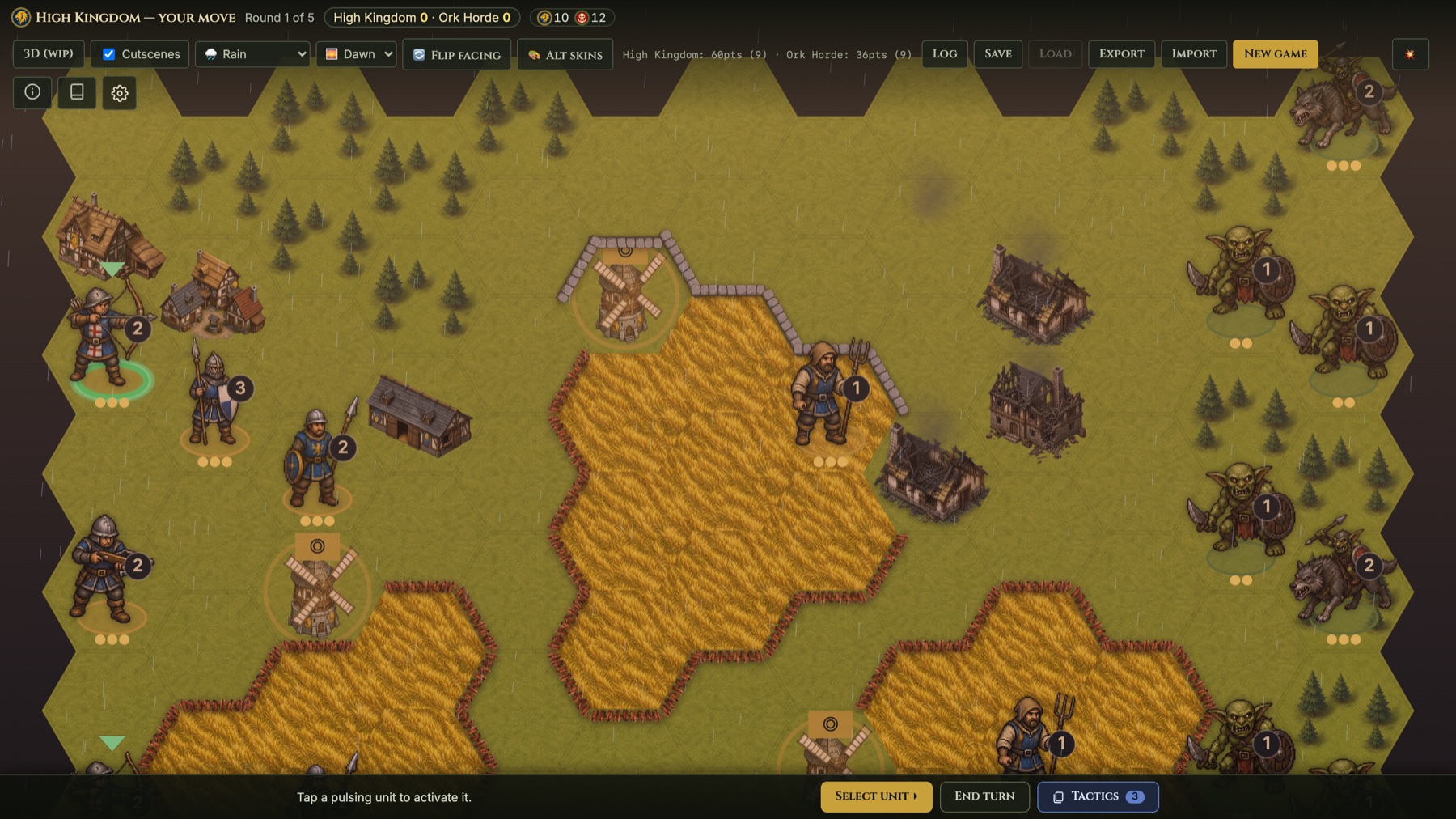
  • Rivers stop you. A ford or a bridge does not, and some crossings are worked by a lever in a nearby tower: hold the tower and the crossing changes.
  • A tower is held by whoever stands in it, and most units cannot climb one.
  • Whoever holds it defends a die better, and anyone assaulting it attacks a die worse.
  • Archers and crossbowmen also shoot a die better FROM a tower. Nobody else gains anything by swinging a sword up there.

War machines

  • A cannon reaches eight hexes and moves or fires, never both.
  • The shot travels hex by hex and can stray, further the longer the shot. A stray shell flattens whatever it finds, including your own men.
  • Roll badly twice over and it bursts at the muzzle and wounds its own crew.
  • A war machine cannot defend itself. Screen it with infantry and keep it back.

The Ogre

  • An Ogre has its own card and does not take an ordinary turn. It draws a hand of Move and Attack cards, one for every life it still holds.
  • They are played in the order they came out. A Move card only moves and an Attack card only swings.
  • A card it cannot use is wasted. Wound it early and its next hand is shorter, so it slows down as it weakens.

Tactic cards

  • You hold a small hand of tactic cards alongside the Battle deck. Each is played once and then gone.
  • Playing one costs no activation, but you may only play one a turn, and only on your own turn.
  • Reinforce restores a unit to full strength, Medic gives one life back, Frenzy adds an attack die and Hardened a defence die.

Magic

  • A caster spends its whole activation on a spell: move or cast, never both.
  • Roll two dice, add the caster’s Magic Skill, and meet or beat the spell’s Casting Value. Fail and the turn is spent but the spell is not lost.
  • Roll two ones and the power turns on its wielder and wounds him.
  • A caster never runs out of spells, so the only cost of casting is the roll.

Winning

  • Read the briefing. Most missions are won by taking ground and holding it, not by killing everything.
  • Ground worth holding is ringed in gold and pays points every turn you stand on it. Kills usually score as well.
  • Many missions run to a turn limit. When the clock stops, the most points wins.

The die

Three skulls, two shields, one blank

Skulls are hits, shields stop them. Skulls minus shields is the damage. One die, six faces, used for everything — there is no second dice type to learn.

3SkullsA hit
2ShieldsStops a hit
1BlankNothing

You can roll it yourself on the combat demo, which uses this exact die.

Modifiers

What changes the dice

Everything that adds or removes a die, and when. Nothing here is hidden from you in play — the game shows each one as it applies it. Rows marked Tabletop only apply under that ruleset.

Attacking

WhenEffect
ChargingMoved two hexes or more into the fight +1 attack die
Shooting from a towerMissile troops only — a swordsman gains nothing by standing higher +1 attack die
Assaulting a towerAttacking anyone who holds it −1 attack die
Shooting across a wallMelee cannot cross one at all −1 attack die
Shooting downhillFiring down onto a lower tier +1 attack die
Striking downhillMelee, one tier down +1 attack die
Fighting uphillMelee, one tier up. Two tiers cannot be reached at all −1 attack die
Battle HardenedThree kills in this battle +1 attack die
Bracing against cavalryUnits with an anti-cavalry stat, against a mounted foe + that unit's value
FrenzyTactic card +1 attack die

Defending

WhenEffect
Holding a towerAnyone in it — stone helps whatever you are +1 defence die
Behind a ditchDefending across one +1 defence die
In coverWoods and the like +1 defence die or more
Shield wallBeside a friendly unit of the same kind +1 defence die
BrokenFailed its morale test −1 defence die
FlankedPressed in melee from two sides at once −1 defence die
Braced against cavalryUnits with an anti-cavalry stat, against a mounted charge + that unit's value
HardenedTactic card +1 defence die

Tabletop only

The wound ward

A hit is warded on a d6 roll of 7 − toughness or more. It is why arrows bounce off an Ogre and why a knight is worth what he costs — a hit that gets past the dice can still be shrugged off entirely.

ToughnessWards a hit on
16+
25+
34+
43+
52+
61+

Classic has no ward — a hit that gets through is a hit. A unit may carry a toughness value for Tabletop play and it simply never comes up.

Rules are easier read on a board

Both demos on the home page run the real thing — the same movement rules, the same die.